Famous INTPs
INTP

Abraham Lincoln
U.S. President (R)
Lincoln: "As I would not be a slave, so I would not be a master. This expresses my idea of democracy."
Lincoln: "I shall try to correct errors when shown to be errors; and I shall adopt new views so fast as they shall appear to be true views."
[When a critic called him a two-faced liar:]
Lincoln: "If I had another face, do you think I would wear this one?"
Lincoln: "[Jefferson's truth was] an abstract truth, applicable to all men and all times. ... All honor to Jefferson."
[Lincoln's law partner:] "He cared little for simple facts. ... [He cared about] the underlying principle of truth and justice."
INTP
Albert Einstein
Physicist
Einstein: "To punish me for my contempt for authority, Fate made me an authority myself."
Einstein: "It is my inner conviction that the development of science seeks in the main to satisfy the longing for pure knowledge."
Robert Oppenheimer: "There was always with him a wonderful purity at once childlike and profoundly stubborn."
Stephen Hawking: "When a book was published entitled '100 Authors Against Einstein,' he retorted, 'If I were wrong, then one would have been enough!'"
INTP
Charles Darwin
Biologist
Darwin: "A scientific man ought to have no wishes, no affections - a mere heart of stone."
Darwin: "From my early youth I have had the strongest desire to understand or explain whatever I observed. ... To group all facts under some general laws."
Darwin: "I love fools' experiments. I am always making them."
Darwin: "Ignorance more frequently begets confidence than does knowledge."
Jung identifies Darwin as E-TJ.
Myers identifies Darwin as an extrovert.
Van der Hoop identifies Darwin as E-TJ.
Keirsey & son identify Darwin as INTP.
INTP
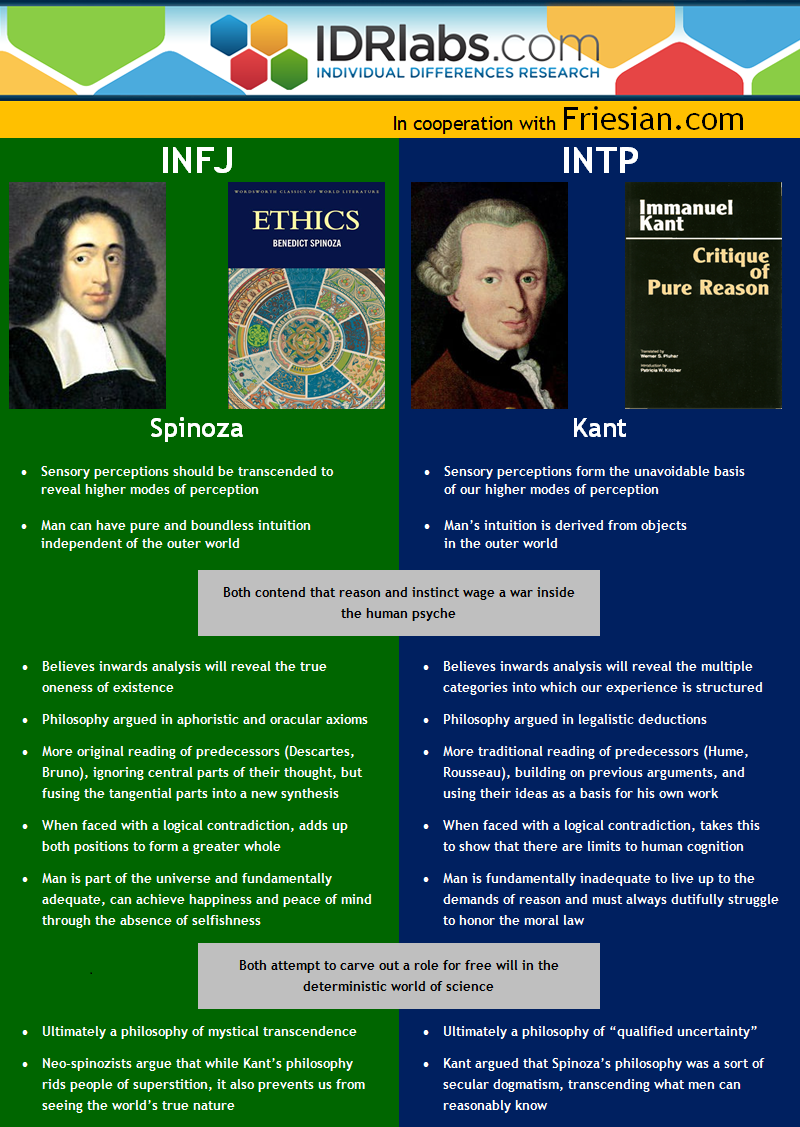
Immanuel Kant
Philosopher
Kant: "If I am to constrain you by any law, it must be one by which I am also bound."
Kant: "[A ruler is merely] the trustee of the rights of other men and he must always stand in dread of having in some way violated these rights."
[His student:] "He encouraged and greatly compelled his hearers to think for themselves; despotism was foreign to his disposition."
Jung identifies Kant as I-TP.
Myers identifies Kant as I-TP.
Von Franz identifies Kant as INTP.
Van der Hoop identifies Kant as I-TP.
Pauli identifies Kant as NF.
INTP
Hannah Arendt
Philosopher and author of 'The Human Condition', dated Martin Heidegger
Arendt: "Thinking ... interrupts all doing, all ordinary activities no matter what they happen to be. ... The moment we start thinking ... we stop everything else."
Arendt: "If the ability to tell right from wrong should have anything to do with the ability to think, then we must be able to 'demand' its exercise in every sane person no matter how erudite or ignorant."
Arendt: "Nietzsche ... has caused [philosophers] so much confusion."
Arendt: "The business of thinking ... undoes every morning what it had finished the night before."
Keirsey & son identify Arendt as INTP.
INTP
Marie Curie
Nobel prize in both physics and chemistry
Curie: "Nothing in life is to be feared, it is only to be understood."
Curie: "I am among those who think that science has great beauty."
Curie: "Be less curious about people and more curious about ideas."
Albert Einstein: "Marie Curie is, of all [famous people], the only one whom fame has not corrupted."
Keirsey & son identify Curie as INTP.
INTP
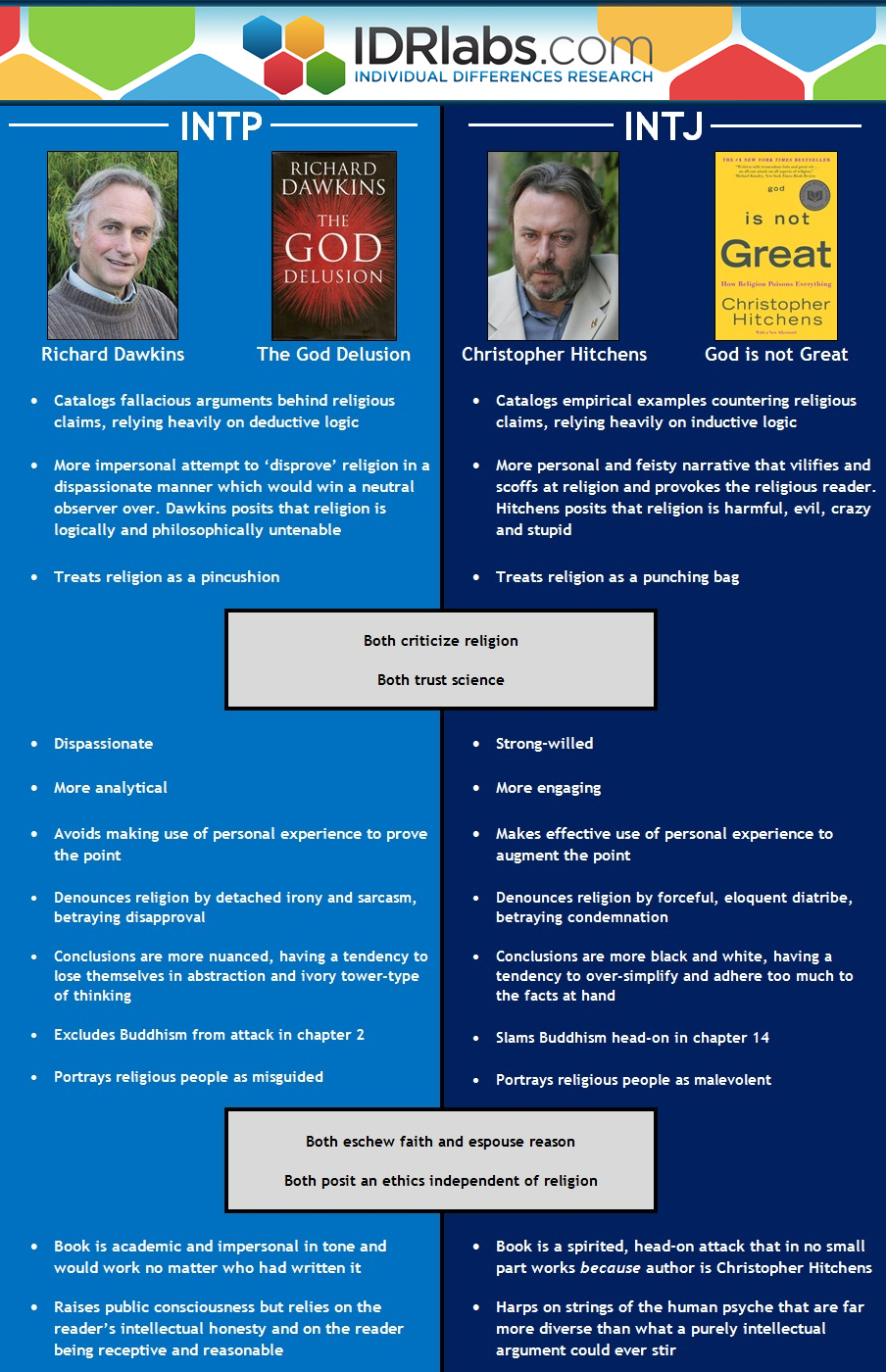
Richard Dawkins
Biologist, author of 'The Selfish Gene' and 'The God Delusion'
Dawkins: "What worries me about religion is that it teaches people to be satisfied with not understanding."
Dawkins: "My passion is for scientific truth. I don't much care about good and evil. ... I care about what's true."
Dawkins: "I don't want to sound callous ... even if I have nothing to offer ... that doesn't mean that what anybody else has to offer [is] true."
[On the school he is considering starting:]
Dawkins: "I am almost pathologically afraid of indoctrinating children. ... It would be a 'Think for Yourself Academy.'"
INTP
John Locke
Philosopher
Locke: "To love truth for truth's sake is ... the seed-plot of all other virtues."
Locke: "Logic is the anatomy of thought."
Locke: "Reading furnishes the mind only with materials of knowledge; it is thinking that makes what we read ours."
Locke: "Religion, which ... ought most particularly elevate us, as rational creatures ... is that where men often appear most irrational, and more senseless than beasts."
INTP
James Madison
U.S. President and author of the Constitution
Madison: "Truth [comes only] from those ... who cultivate their reason."
Madison: "In ... assemblies ... passion [wrests] the scepter from reason. Had every Athenian citizen been a Socrates, every Athenian assembly would still have been a mob."
Garry Wills: "As a framer and defender of the Constitution [Madison] had no peer."
Richard Brookhiser: "Madison lived in his head and public speaking did not come naturally to him."
Joseph J. Ellis: "[His contemporaries liked to say that] if God was in the details [of a law] Madison was usually there to greet Him."
Richard Brookhiser: "Madison loathed Hamilton and loved Jefferson above all."
Keirsey & son identify Madison as INTP.
INTP
Adam Smith
Economist
Smith: "Science is the great antidote to the poison of enthusiasm and superstition."
Smith: "[I endeavor to find] the connecting principles of nature ... which bind together all ... disjointed objects. [Principles] introduce order into this chaos of jarring and discordant appearances."
Smith: "[To discover principles is] to allay the tumult of the imagination, and to restore it ... to ... tranquility and composure."
Smith: "I am a slow, a very slow workman. [I] do and undo everything I write at least half a dozen of times before I can be tolerably pleased with it."
Milton Friedman: "There is not a line in 'The Wealth of Nations' that is not still applicable to this day."
Keirsey & son identify Smith as INTP.
INTP
Friedrich A. Hayek
Economist and philosopher, author of 'The Road to Serfdom', student of Mises, cousin of Wittgenstein
Hayek: "It may indeed prove to be far the most difficult and not the least important task for human reason rationally to comprehend its own limitations."
Milton Friedman: "My interest in political philosophy was rather casual until I met Hayek."
Ronald Reagan: "Hayek is amongst the top 2-3 of the all the people who ever influenced me."
[Banging a copy of Hayek's 'The Constitution of Liberty' on the table at a policy meeting in the Conservative Party:]
Margaret Thatcher: "This is what we believe!"
Karl Popper: "I have learned more from Hayek than from any other living thinker, except perhaps Alfred Tarski - but not even excepting Russell."
Keirsey & son identify Hayek as NT.
INTP
Milton Friedman
Economist, father of David Friedman
Friedman: "To really understand something you've got to reduce it to its principles."
Friedman: "In every discipline, progress comes from people who make hypotheses, most of which turn out to be wrong, but all of which ultimately point to the right answer."
[Asked if he was a libertarian:]
Friedman: "I'm much more interested in having people thinking about the ideas, rather than the person."
Friedman: "The proper role of government is exactly what John Stuart Mill said. ... The proper role of government is to prevent other people from harming an individual [and not much else]."
David Friedman: "[With my father] it was simply taken for granted that what mattered was how good your arguments were, not who was making them."
INTP
Thomas Aquinas
Philosopher and theologian
Aquinas: "Reason in man is rather like God in the world."
Anthony Kenny: "[To Aquinas] the senses are what we have in common with dumb animals. ... Our better part [is] the mind ... and [its] intellectual contemplation."
Anthony Kenny: "[To Aquinas] the intellect [stands] at the summit of ... the human soul."
Ayn Rand: "Aquinas brought an Aristotelian view of reason back into European culture, and lighted the way toward the Renaissance."
C.G. Jung: "St. Thomas is really a great man quite apart from his saintliness."
INTP
Rene Descartes
Philosopher
Descartes: "Cogito ergo sum."
("I think, therefore I am.")
Descartes: "Each problem that I solved became a rule, which served afterwards to solve other problems."
Allen W. Wood: "Descartes recommended that we distrust the senses and rely on the ... use of our intellect."
Kelley L. Ross: "Descartes is justly regarded as the Father of Modern Philosophy. This is not because of the positive results of his investigations, which were few, but because of the questions ... and problems that he [raised], problems that have still not been answered."
Journal of First Principles: "Descartes ... taught that the cause of error lies in the will, not the intellect."
Pauli identifies Descartes as a T type.
INTP
Parmenides
Greek philosopher, mentor of Zeno and Empedocles
Parmenides: "Let reason alone decide."
Daniel W. Graham: "It may be a historical fact that Parmenides is a kind of super-logician."
Scott Austin: "[The thinking of] later philosophers appears softer by comparison."
Karl Popper: "I have spoken to Einstein and he admitted to me that his theory was in fact no different from the one of Parmenides."
Karl Popper: "[To] interpret Parmenides as a Kant before Kant ... this is exactly what we must do."
Timon of Phlius: "It was high-minded Parmenides ... who introduced thought instead of imagination's deceit."
INTP
Thucydides
Greek historian
Thucydides: "Few things are brought to a successful issue by impetuous desire, but most by calm and prudent forethought."
Thucydides: "The bravest are surely those who have the clearest [understanding of] what is before them ... and yet notwithstanding, go out to meet it."
Jared Diamond: "[His] insights into politics and war are universal and still relevant; his moral and psychological reflections on war and history are profound."
Jared Diamond: "His book is considered to have laid the foundations of the discipline of history."
INTP
Jimmy Wales
Founder of Wikipedia
Wales: "My style is somehow reflected in the Wikipedia style. A friend says it's a really good quality and also very infuriating that I'm so neutral all the time."
[When told he has been called a new and more open type of leader, the opposite of the command and control of Jack Welch:]
Wales: "I think there is something to that, in fact to the point where I am not always comfortable being called a leader."
[On testing ESTP on a Jungian type test:]
Wales: "The description ... sounds distasteful to me."
The Guardian: "He is, above all, a believer in reason."
Wales' results on a Jungian type test score him as both ESTP and ENFJ.
INTP
Paul Allen
Founder of Microsoft along with Bill Gates
Allen: "My style [is] to absorb all the data I [can] to make the best-informed decision possible ... sometimes to the point of over-analysis."
Allen: "I'm a stubbornly logical person."
Allen: "Bill Gates and I [soon] found a groove together. I was the idea man. ... Bill listened and challenged me, and then homed in on my best ideas to help make them a reality. Our collaboration had a natural tension, but mostly it worked productively and well."
Allen: "Bill would test my ideas. I would come to him with another 10 ideas that never went anywhere - he was the sanity check. [But] when it came to selling and marketing ... he was much more excited on the business side, so we became very complementary."
INTP
Larry Page
Founder of Google along with Sergey Brin, dated Marissa Mayer
Page: "Building things ... is a really interesting intellectual exercise."
Page: "I find that [pursuing truth] is more important than trying to control people."
Page: "Part of our brand is that we're pretty understated."
Page: "Google is actually a great argument for [doing] pure research [because] we didn't start out to do a search engine at all."
Page: "[Steve Jobs] kept telling me, 'You're doing too much at once.'"
Jan Yarow: "Page is more interested ... in lots of weird side projects [whereas] Mark Zuckerberg is focused 100% on Facebook's core business, and has never seemed to waver from that."
INTP
Sergey Brin
Founder of Google along with Larry Page
Brin: "I never rooted for [my schools'] sports teams. I was never one of the crowd supporting something or not. I like to maintain my independence."
Brin: "Managing people, and being emotionally sensitive, and all the skills you learn in terms of communication and keeping people motivated - [for me] that has been a challenge."
[Interviewer: "Do you tell yourself 'I changed the world'?"]
Brin: "That would be a little bit self-centered."
Larry Page: "[When Sergey and I first met] I thought he was pretty obnoxious. He had really strong opinions about things, and I guess I did, too."
John Battelle: "The Google founders are two swords sharpening one another."
INTP
Jane Austen
Author of 'Pride and Prejudice'
Austen: "I could not ... write a serious romance [except] to save my life; and if [I had] to keep it up and [not laugh] at myself ... I am sure I should be hung before I had finished the first chapter."
Susan Zlotnick: "She is really a sociologist and a historian, anatomizing the social and economic arrangements of her day."
Virginia Woolf: "Her chief tool [is] comic genius [disguised as] decorous panegyric or matter-of-fact description."
Sam Bailey: "Jane Austen's irony is devastating in its exposure of foolishness and hypocrisy."
Stephanie Wardrop: "Both [Jane Austen] and [Tina Fey] turn their sharp tongues on the idiots around them and both view the world through a satirist's eyes."
INTP
John le Carre
Author of spy novels
Le Carre: "I think that all writers feel alienated. ... I know that I do. ... I still feel, as I think most creative people do, absolutely isolated."
Le Carre: "[My novels] introduce levels of intelligence ... moral doubt [and] self-doubt, which may not pertain [to real-world espionage]."
New York Times: "He doesn't attend book parties; he doesn't compete for, nor accept, book prizes. ... He dislikes book tours and interviews."
New York Times: "Readers [who are] mostly allergic to spy stories and genre narratives have long been drawn to le Carre ... because of the wit and incisiveness he manages to insert into pained understatement."
INTP
Alan Greenspan
Chairman of the Federal Reserve, dated Barbara Walters
Greenspan: "I had always viewed myself as an observer of events, never as a partaker of them."
Greenspan: "I've never been entirely comfortable being cast as the person who calls the shots."
Greenspan: "I'm hardly Adam Smith, but I've got the same inquisitiveness about understanding the broad forces that define our age."
Greenspan: "I get so engaged when I have a problem [I] cannot solve, that I just cannot break away from what I am doing - I keep thinking and thinking and cannot stop."
INTP
Albert Speer
Minister of Armaments in Nazi Germany
Speer: "There are things for which one is guilty even if one might offer excuses - simply because the crime is so overwhelming that by comparison any human excuse pales to insignificance."
Speer: "Technology [can be used] to multiply [genocide]. ... The more technological the world becomes, the more essential ... individual freedom and the self-awareness of the individual human being [will be] as a counterpoise to technology."
Speer: "For all writers of history, Eva Braun is going to be a disappointment."
At the Nuremberg Trials, Speer's IQ was tested to be 128.
INTPs in popular culture
INTP
David Cronenberg
Filmmaker
Cronenberg: "I try to make things clear; I never try to make things deliberately ambivalent or cloudy."
Cronenberg: "I'm [not] looking in fear at science ... and worrying about where it's leading us. That's not the way I feel about it at all. I feel an incredible empathy for the process of science."
Andrew O'Hehir: "[Cronenberg] is a genuine intellectual. ... It'd be easy to imagine him as a writer or philosopher or historian."
Peter Garrett: "[He] is a cheerful, deep-thinking, mild-mannered college professor type."
Sam Maronie: "He is modest [and] in many ways ... his own worst critic."
INTP
Jesse Eisenberg
Actor, dated Mia Wasikowska
Eisenberg: "I can't exist in normal group situations ... where you have to ... jockey for position. I ... just withdraw."
Eisenberg: "[I became an actor through a] series of really weird events. ... I don't think I ever would've tried to be an actor."
Eisenberg: "[When] acting, then there's a prescribed way to behave; whereas in life there's no prescribed way. So acting [is] a comfortable way to get through the day."
Eisenberg: "When I was acting in a play I liked knowing my place - that I was this role, and other people were that role, and we could interact with each other in a way I felt was very clear to me."
Stephen Whitty: "His characters usually have a few things in common. They're extremely bright [and] yet they often seem more than a little confused about what people around them expect, emotionally."
INTP
Charlotte Gainsbourg
Actress and singer
Gainsbourg: "I didn't [try] to become [a performer]; it just happened when I was really young and then continued."
Gainsbourg: "I've never thought of myself as being an actress or being a singer. I'm uncomfortable with both."
Gainsbourg: "Everything that [deals with] being isolated I've felt very close to. ... Isolation [is] something ... that I understand well."
Gainsbourg: "It's normal to judge yourself and to be your own worst critic. It keeps you in a kind of reality."
Gainsbourg: "Self-questioning is my method."
INTP
Sigourney Weaver
Actress
Weaver: "[In my youth] I was very shy, very self-conscious. I didn't even decide to be an actress until [people] kept hiring me. I kind of backed into it."
[On her choice of characters:]
Weaver: "I've always been drawn to women who aren't very comfortable in the world. Who are isolated."
Weaver: "Have I ever doubted myself? Have I ever not?"
Weaver: "I feel self-doubt whether I'm doing something hard or easy."
Weaver: "Most [directors] didn't know what to do with me, so I ended up working with Ridley Scott and James Cameron. People who didn't much care for convention."
INTP
Tina Fey
Comedic writer and actress
Fey: "Comedy is only funny when it is telling the truth."
Fey: "I live every writer's fantasy of being mostly a writer, but getting to be on TV just a little bit to get acknowledgment for being a writer."
Fey: "Being a good boss means hiring talented people and then getting out of their way."
Amy Poehler: "[She doesn't] belly-flop into the pool at the pool party. She watches everybody else's flops and then writes a play about it."
Alec Baldwin: "She's so bright you're always wondering if you're boring her."
Unusually for INTPs, Fey also has Narcissistic traits.
INTP
Asia Carrera
Adult film actress and member of Mensa
Carrera: "The more I learned about the histories of organized religion, the more convinced I became that people are extremely gullible, and that I need to get off my ass and start a religion of my own!"
Carrera: "[I am one of the guys when it comes to] gaming or computer skills, or even just all-around geekiness."
Carrera: "[My hobbies include] studying Wall Street and quantum physics."
Carrera: "I don't have a TV, and I don't party or socialize."
INTP
Ben Stein
Game show host and writer
Stein: "I am, by nature, a tourist everywhere I go, especially at home, and I spend much of my time and energy analyzing what I observe."
Stein: "In my life, I am cursed ... by a habit of categorization. I see some examples, make a hypothesis based upon them, test that hypothesis, and if it works, I adopt it as a predictor and explainer of the human condition."
Stein [to the host on FOX News:] "You are doing the classic post hoc ergo propter hoc fallacy."
George Miller: "His past is actually tightly woven with higher education, academia, and law. In fact, his personal history reads much more like a tenured professor's than a former game-show host."
Unusually for INTPs, Stein also has Antisocial traits.
INTP
Andreas Scholl
Countertenor
Scholl: "This is always a question for each singer to answer for himself. What do I stand for? What are my ideas? What am I doing?"
Scholl: "Some people ask me: 'Don't you feel limited by [only] singing Renaissance and Baroque music?' Well, [I reply] that is most of [the music] till this very day!"
Scholl: "[I am German in the sense that] Germans are known to be very self-critical and not too enthusiastic about themselves. ... We are not over-confident or praising ourselves too much."
INTP
Glenn Gould
Pianist
Gould: "I would like to see a world where nobody cared what anybody else was doing - in which ... group-think ... disappeared."
Gould: "I find it very depressing to hear about situations in which [competition and imitation] rule creativity. I can't think of anything less important."
Gould: "[In my favorite music] all of the extroversion, all of the superfluous excitement is gone."
Gould: "All of the subjects that I've chosen have had to do with isolation. ... The whole idea of [people] gathering ... doesn't really appeal to me."
Unusually for INTPs, Gould also has Narcissistic traits.
Gould identifies himself as having Narcissistic traits.
INTP
Richard Ayoade
Actor and director
Ayoade: "It feels completely inappropriate to try to persuade people to see [my movies]. It feels like lobbying for your own exam results."
Ayoade: "I [find it] odd when people go, 'I worked very hard for this and I deserved it,' because lots of people work very hard and deserve things, so [it] seems somewhat self-aggrandizing, as though you have complete command over your destiny."
Ayoade: "[The way I got into acting] was largely accidental."
Ayoade: "I really like Matt Stone and Trey Parker's stuff. Anything they do is great."
The Guardian: "Ayoade is big on suggesting that everything that's happened to him has happened by accident, or at least by default, never by design."
INTP
Randall Munroe
Cartoonist famous for 'xkcd'
Munroe: "Noticing when the stoplights are in sync, or calculating the length of your strides between floor tiles - normal people notice that kind of stuff, but a certain kind of person will do some calculations."
Munroe: "I go to goth clubs dressed as a frat guy so I can stand around and look terribly uncomfortable. At frat parties I do the same thing, but the other way around."
About INTPs
- Abstract-minded systems analysts
- Strongly linked to the Schizotypal personality
- Somewhat linked to the Schizoid personality
- More common amongst men than amongst women
- Repress their Extroverted Feeling function, meaning that they may have difficulty emoting and figuring out what others need from them emotionally
- Test: INTP or ENTP?
- Test: INTP or INTJ?
- Test: INTP or ISTP?
- Test: INTP or INFP?
- Test: INTP or INFJ?
- INTP Career Interview 1
- Another Look at INTP
INTP Functions
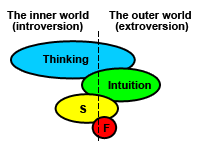
| 1. Dominant: | Introverted Thinking |
| 2. Auxiliary: | Extroverted Intuition |
| 3. Tertiary: | Introverted Sensing |
| 4. Inferior: | Extroverted Feeling |
Even more INTPs
- We have over 30 more notable INTPs as part of our extended content
Get access: Learn more
Already a member?
- Forgot your password?